Annapolis Doesn’t Care About the Eastern Shore
March 28, 2026
By David Lee
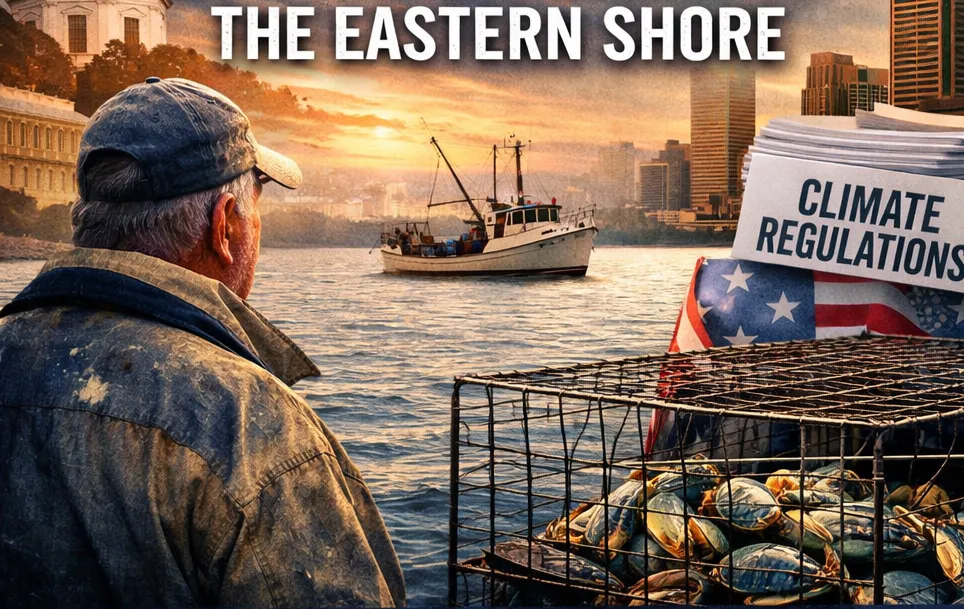
There is a long tradition in Maryland politics of candidates promising to listen to rural communities once they get to Annapolis. Unfortunately, there is an equally long tradition of those promises fading once the governing begins. The latest example appears to be unfolding along the waters of the Chesapeake Bay, where fishermen and watermen on the Eastern Shore say they were promised a voice in state policy by Governor Wes Moore, only to find themselves pushed aside.
The frustration was recently highlighted in a FOX45 Spotlight on Maryland investigation featuring Captain Robert Newbury, a longtime waterman and chairman of the Delmarva Fisheries Association. Newbury has spent more than four decades working on the Chesapeake Bay, and he believed that when Governor Moore first visited the Eastern Shore in February 2023, the state might finally begin listening to the people whose livelihoods depend on the water.
According to Newbury, the governor told him that the seafood industry would have a seat at the table and that his passion for the bay was unlike anything Moore had seen. For a moment, it appeared that the new administration might take a different approach from the usual Annapolis pattern of announcing policies first and consulting local communities later.
That optimism did not last long.
Newbury says the promise of engagement quickly evaporated. Since that meeting in early 2023, he says he has not heard from the governor or his administration. Instead, the Moore administration has accelerated environmental and regulatory policies that many fishermen believe are putting the Chesapeake Bay seafood industry at risk.
Among the policies drawing criticism is the aggressive implementation of the Climate Solutions Now Act, a sweeping environmental law aimed at reducing Maryland’s greenhouse gas emissions. Governor Moore has also allocated tens of millions of dollars toward climate initiatives and environmental planning through the Maryland Department of the Environment. The administration argues these policies are necessary to protect coastal communities from rising sea levels and environmental degradation.
But for many watermen, the policies coming out of Annapolis feel less like environmental stewardship and more like economic suffocation.
Newbury describes the impact on fishermen as death by a thousand cuts. Regulations on striped bass harvesting, catch limits, and additional restrictions have dramatically altered the economics of fishing in Chesapeake Bay. The striped bass fishery has been at the center of controversy after regulators adopted tighter restrictions intended to help rebuild the species population.
Watermen do not necessarily dispute the need to preserve fish stocks. After all, no one has a stronger interest in sustaining the bay’s resources than the people whose livelihoods depend on them. What they dispute is the process. Many fishermen say decisions affecting their industry are being made by regulators and policymakers without their input, who have little understanding of how the industry actually operates.
The frustration expressed by Newbury reflects a broader cultural and political divide within Maryland. The state’s population and political power are heavily concentrated in the Baltimore and Washington metropolitan areas, while the Eastern Shore remains largely rural. That divide has grown more pronounced as Annapolis increasingly focuses on climate policy, urban priorities, and large-scale environmental regulation.
For people who make their living from the land and water, those policies often feel disconnected from reality.
The irony is that fishing and farming are deeply embedded in Maryland’s history. The Maryland state seal itself includes images of a farmer and a fisherman representing what the seal calls the bounty of the land and water. Those symbols were chosen centuries ago because agriculture and fishing were the foundation of the state’s economy.
Today, many watermen believe those traditions are being pushed aside in favor of political messaging about climate policy.
Newbury expressed that frustration in stark terms. If fishermen are not given a seat at the table, he said, then they end up on the menu. In his view, the Moore administration has not simply left watermen behind but has abandoned them entirely.
The dispute may not end with rhetoric. Watermen are increasingly exploring legal options to challenge regulations that they believe are unfair or improperly implemented. Newbury and others have suggested that ongoing conflicts over striped bass regulations and other policies could eventually lead to major court battles.
If that happens, it would represent yet another chapter in the long-running struggle between government regulators and the industries that depend on Chesapeake Bay resources.
The Moore administration declined requests for interviews in the FOX45 report examining these concerns. ³ That silence has only deepened the frustration felt by fishermen who believe their voices are being ignored.
Governor Moore has repeatedly emphasized that no community should be left behind as Maryland confronts environmental and economic challenges. That message resonates across the state. But slogans alone are not enough.
Real leadership requires listening to the people whose lives are affected by policy decisions.
The fishermen of the Eastern Shore are not asking for special treatment. They are asking for something far more basic. They want to be heard before decisions are made that could determine whether their industry survives.
For generations, Maryland’s watermen have been stewards of the Chesapeake Bay. They understand the rhythms of the water, the behavior of fish stocks, and the fragile balance that keeps the bay alive.
If Annapolis wants to craft policies that truly protect the Chesapeake Bay, it would be wise to remember that the people who know the bay best are the ones who work on it every day.
Ignoring them is not just bad politics.
It is bad policy.
Endnotes
- Maryland Department of the Environment. “Climate Solutions Now Act Implementation.”
https://mde.maryland.gov/programs/air/Climate-in-md/Pages/Homepage%20For%20Climate.aspx - Maryland Department of Natural Resources. “Atlantic Striped Bass Management and Regulations.” https://dnr.maryland.gov/fisheries/pages/striped_bass.aspx
FOX45 News. “Spotlight on Maryland: Watermen Say Governor Moore Ignored Promises to Eastern Shore Fishermen.”
https://foxbaltimore.com/spotlight-on-maryland/eastern-shore-captain-says-moore-abandoned-watermen-after-promise


About The Author
