A PLAYING FIELD THAT ISN’T LEVEL: CANADA OPENS THE FLOODGATES WHILE AMERICAN FISHERMEN FACE TIGHTER RESTRICTIONS
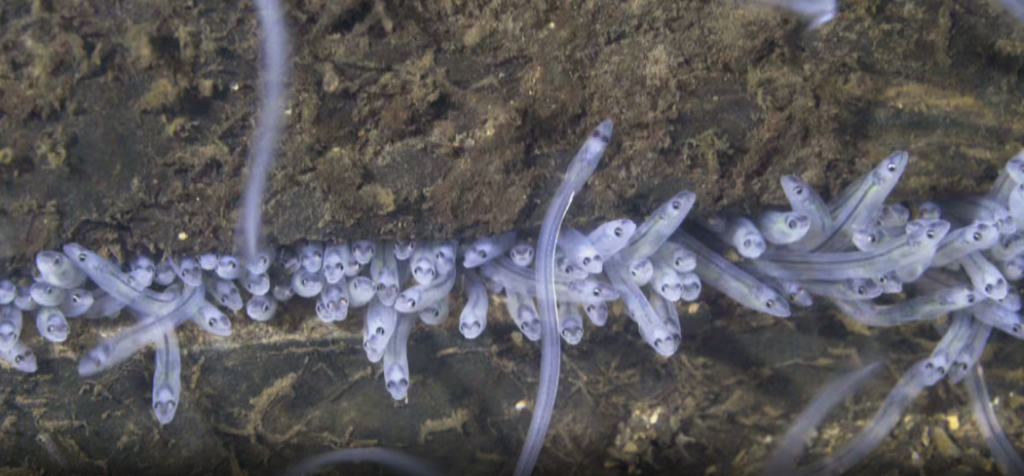
Image from the CBC.
Once again, American commercial fishermen are being asked to shoulder the burden of conservation while our neighbors to the north are handed a competitive advantage, while our own federal government looks the other way.
This week, Canada’s Department of Fisheries and Oceans (DFO) announced a 22% increase to its elver (glass eel) quota for the 2026 season, raising the total allowable catch to 12,180 kilograms. This is the first quota increase in 20 years for one of the most valuable fisheries on the planet, with elvers fetching up to $2270 per lb. on Asian markets. Canada’s rationale? That illegal fishing has come under better control and that the population appears stable.
Meanwhile, here in the United States, the Atlantic States Marine Fisheries Commission (ASMFC) has moved in the opposite direction. The coastwide harvest cap for yellow eel has been reduced to 518,281 pounds, reflecting ongoing concern about population decline. Maine holds the only permitted glass eel quota on the East Coast, fixed at just 9,688 pounds, unchanged since 2013, while other Atlantic states, including Maryland, are shut out of the glass eel fishery entirely.
Let that contrast sink in: Canada is increasing its elver quota by over 22% while U.S. fishermen are being tightened, restricted, and squeezed out of the same market for the same shared species.
The American eel does not recognize the U.S.-Canada border. It migrates the length of the Eastern Seaboard and beyond, all the way to the Sargasso Sea to spawn. When Maryland fishermen are denied access and forced to watch harvests decline under strict federal oversight, while Canadian fishermen are simultaneously expanding their take just miles up the coast, we are not engaged in shared stewardship. We are engaged in unilateral sacrifice.
And this isn’t just an eel issue. We have seen this same pattern play out with striped bass, where Maryland and Delmarva watermen have endured season closures, reduced slot limits, and strict accountability measures, while Canadian waters continue to produce without comparable restrictions on their harvest. We have seen it with lobster, where Canadian production has expanded dramatically while U.S. fishermen along the Atlantic coast face increasingly burdensome gear restrictions and regulatory costs.
The Delmarva fishing community is not opposed to conservation. We live and work on these waters; we have more at stake in their long-term health than any regulator sitting behind a desk in Washington or Ottawa. What we are opposed to is a regulatory framework that holds American fishermen to one standard and ignores what is happening just across an invisible line in the water.
If the science says the eel population requires protection, that standard must be applied internationally and not selectively imposed on the American fleet while Canadian quotas expand.
We call on NOAA Fisheries, the ASMFC, and our representatives in Congress to wake up to this disparity. We need binding international fisheries agreements with Canada that ensure any conservation burden is shared equally. We need our federal government to raise these concerns in trade and diplomatic negotiations. And we need our voices to be heard by the ASMFC before more Maryland and Delmarva fishing families are regulated out of existence while watching their livelihoods harvested by others.
The American fisherman has taken one too many on the chin. It’s time our government stepped up to the plate.
— Rob Newberry
President & Chairman, Delmarva Fisheries Association
President & Chairman, Delmarva Fisheries Association
Stay Connected - DFA Social Media


About The Author
