Eastern Shore captain says Gov. Wes Moore abandoned watermen after promise
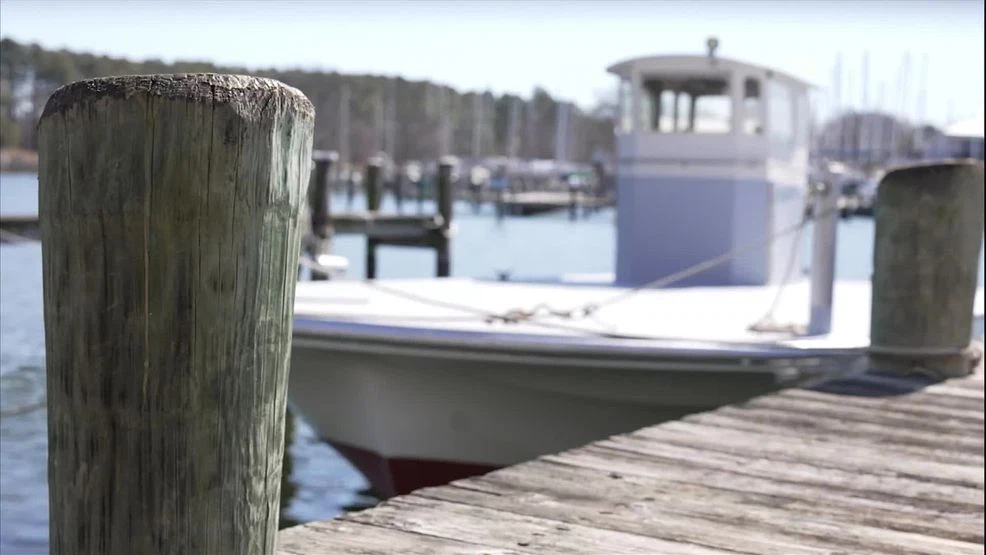
Photo by Steve Pierce
Article by GARY COLLINS | Spotlight on Maryland | FoxBaltimore
Thu, March 5, 2026
ROCK HALL, Md. — On Feb. 14, 2023, during his first official visit to Maryland’s Eastern Shore as governor, Wes Moore stood before a group of local leaders and watermen and reflected on the state’s coastal identity.
“This is Maryland. I mean, look at this group,” Moore said in Easton that day.
Among those listening was Capt. Robert Newberry, a multigenerational fisherman and volunteer chairman of the Delmarva Fisheries Association. From a dock along the Chesapeake Bay in Rock Hall, Newberry recalls what he says was a direct promise from the newly elected governor.
“That basically, I’m the go-to man,” Newberry said. “That my passion for the Bay, he has never seen anything like it. That the waterman and the seafood industry will have a seat at the table.”

An empty fisherman’s boat is docked at a marina in Rock Hall, Md., on Saturday, February 28, 2026. (Steve Pierce/Spotlight on Maryland)
Over three years later, Newberry says Moore’s promised access never materialized.
Spotlight on Maryland sought to examine whether Moore’s administration has engaged Eastern Shore watermen after pledging to unify Maryland’s regions under the slogan “Leave No One Behind.” Newberry, who leads a regional fisheries group representing watermen across three states, says he has had no direct communication with the governor or his administration since that early 2023 meeting – even as new environmental regulations and fishing restrictions have reshaped the industry.
Moore declined Spotlight on Maryland’s request for an interview for this story.
A lifetime on the Chesapeake Bay
Newberry has navigated the waters of the Chesapeake Bay for more than four decades as captain of the vessel Open Ticket. He leads the Delmarva Fisheries Association, which advocates for commercial and charter fishermen across the Bay waters in Delaware, Maryland and Virginia.
It’s been a very hard road,” Newberry said. “We’ve been basically put to death by a thousand cuts.”
He traces regulatory battles across multiple administrations, from Democratic Gov. Harry Hughes to Republican Gov. Larry Hogan, arguing that commercial watermen have long struggled to balance conservation policy with economic survival.
Newberry said conditions have rapidly declined under the Moore-Miller administration.
Commercial fishermen and charter operators sued the Atlantic States Marine Fisheries Commission over new striped bass catch limits that reduced commercial quotas and limited recreational anglers to one fish. Court records show the plaintiffs, including Delmarva Fisheries, argued the rules were unlawful and would cause major economic harm.
A federal court denied their request to block the rules, finding the plaintiffs lacked standing and that the restrictions were imposed by the state, not directly by the Commission, which Newberry said are still being legally pursued for relief.
Transition team and expectations
Newberry said he became engaged with Moore’s political orbit during the gubernatorial transition.During the transition team,”
Newberry said, “a gentleman put my name in the hat, and I got a phone call, and they wanted me to serve in one of the at-large positions on the transition team.”
He later learned there were roughly 1,200 at-large appointees. “I always thought (it) was prestigious, but I found out there were 1,200 other at-large people with me, and I went ‘uh oh.’”
Within Moore’s first year, the administration moved to implement Maryland’s sweeping environmental law, the Climate Solutions Now Act. Passed by the General Assembly in 2022, the measure requires the state to cut greenhouse gas emissions 60 percent by 2031 and reach net-zero by 2045, making Maryland among the most aggressive climate policy states in the country.
Moore doubled down on the initiative within months of taking office in 2023.
The governor signed three green energy bills in April 2023, including the Maryland Promotion Offshore Wind Energy Resource Act, or the POWER Act. During the bill signings, the governor announced his accelerated net-zero emissions target for Maryland, aiming to reach 100% carbon-free energy generation by 2035 – a full decade ahead of the state’s statutory requirement.
Meanwhile, in November 2023, the Maryland Department of Natural Resources, submitted emergency regulations to implement a one fish per person per diem rule. Citing the effort aimed at managing the striped bass population in the Bay, the regulations also implemented strict size guidelines for harvesting, according to DNR’s website.
Moore echoed his climate and environmental efforts in a promotional social media video posted on YouTube in March 2024.
“Just weeks ago, we allocated $90 million dollars to advance the implementation of the new Climate Solutions Now Act and our Department of the Environment climate plan,” Moore said at a public event.
The governor framed climate resilience as central to Maryland’s coastal geography in the video.
“Protection of our environment is not just a nicety. Seventy-two percent of Marylanders live and work along the coast and will be directly affected by sea level rises and coastal erosions,” Moore said.
State environmental officials have said climate-driven warming, habitat loss, and declining fish stocks necessitate tighter regulations, particularly on striped bass, a keystone species in the Chesapeake Bay economy known as rockfish.
‘We have to fight for ourselves’
Newberry argues that subsequent restrictions, including limits on recreational charter catches of striped bass – one fish per person during certain seasons – have strained charter operators and commercial fishermen alike.
He says regulatory decisions affecting striped bass were implemented without direct consultation with him or other Eastern Shore leaders he believed would be engaged.
“If they cared about what we have done, they would have reached out to me in 2023 when regulations were coming through,” Newberry said. “No contact. Take it. Leave it. Goodbye.”

Fishermen across the Atlantic coast have been entangled in litigation and regulatory disputes as the Atlantic States Marine Fisheries Commission tightened quotas in response to declining stock assessments. Newberry said disagreements over striped bass management are reaching the level of the U.S. Supreme Court, though conservation agencies maintain the restrictions are designed to prevent fishery collapse.
“Fighting? Well, I mean, we have to fight for ourselves,” Newberry said. “We’re having to wind up in the Supreme Court on issues we have with striped bass.”
Newberry said the governor and DNR have not responded to pleas for collaboration to roll back regulations hurting the state’s watermen industry since February 2023.
‘A seat at the table’
When asked whether he believes Moore has left watermen behind, Newberry rejected the phrasing.
“I don’t know if left behind, but he’s abandoned us,” Newberry said. “Since that date that I met him back in February 2023, we’ve heard nothing.”
He invoked a familiar warning from political negotiation.
The old saying, if you don’t have a seat at the table, you’re on the menu — we’re not even on the menu. We’ve been abandoned,” Newberry said.
Newberry said the symbolism of the Maryland state seal weighs heavily on him. The seal depicts a farmer and a fisherman flanking the Calvert family shield, a visual representation of agriculture and maritime industry as twin economic pillars.

A seagull takes flight along the Chesapeake Bay on Saturday, February 28, 2026, in Rock Hall, Md., on the state’s Eastern Shore. (Steve Pierce/Spotlight on Maryland)
“The state seal, on the left side there is a plowman, and the right, a fisherman,” Newberry said. “And the title of it is for the bounty of the land and the water.”
He questioned whether state policy still reflects that heritage.
“What they should do is remove the farmer and remove the waterman,” he said, suggesting that policy priorities appear centered elsewhere. “Everything seems to be based around Baltimore not the Eastern Shore, because we’re rural.”
A broader economic divide
The Chesapeake Bay seafood industry generates hundreds of millions of dollars annually in economic impact, supporting watermen, processing facilities, tourism operators, and related businesses across counties such as Kent, Talbot, and Dorchester.
At the same time, climate adaptation and environmental compliance costs are rising. Amid two years of billion-dollar deficits, the Moore administration has directed funding toward clean energy, shoreline resilience, and wastewater treatment upgrades, measures state officials argue protect long-term economic viability along the coast.
Newberry sees the situation differently.
“Look what he’s done for the farmers. Look what he’s done for the waterman. Look what he has done with our economy here,” Newberry said.
From the dock in Rock Hall, he reflects on the elemental forces that sustain his livelihood.
“Well, water is the source of all life,” Newberry said. “Without water, we have no life. We got the water, the wind, and the sky.”
Spotlight on Maryland will continue to report on how the Moore administration is impacting Marylanders across the state, including those who have benefited most from the governor’s first term. Send news tips to [email protected] or contact Spotlight on Maryland’s hotline at (410) 467-4670.


About The Author
